
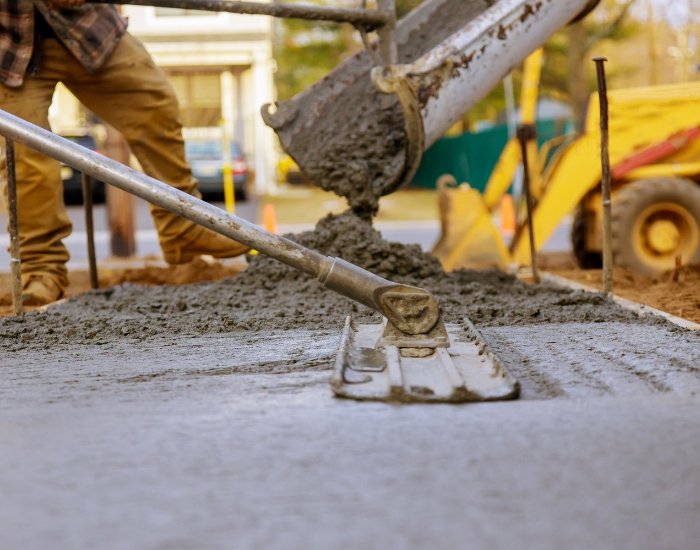
Concrete is one of the most commonly used construction materials in residential and commercial projects. Whether you’re planning a driveway, patio, sidewalk, or foundation, understanding how much concrete is in a yard is essential for budgeting, ordering, and ensuring your project runs smoothly.
In Texas, including Katy, Cypress, and Spring, homeowners and contractors often work with large-scale pours that require careful planning to avoid waste, extra costs, or delays. This guide explains concrete volume, how to calculate the amount needed, and tips for efficient ordering.
Table of Contents
- Understanding a Concrete Yard
- Converting Measurements: Cubic Feet vs Cubic Yards
- Calculating Concrete for Common Projects
- Factors That Affect Concrete Requirements
- Ordering Concrete: Tips for Accuracy
- Reducing Waste and Extra Costs
- Professional Tools and Services for Accurate Estimation
- Frequently Asked Questions
- Final Thoughts
1. Understanding a Concrete Yard
A “yard” in construction refers to a cubic yard, which is a volume measurement rather than a surface area. One cubic yard equals 27 cubic feet (3 feet × 3 feet × 3 feet). Understanding this distinction is crucial because projects are often measured in length, width, and thickness, which must then be converted into cubic yards for ordering.
Concrete is typically sold by the cubic yard for bulk delivery, whether delivered via truck for large projects or mixed on-site. Ordering by yard ensures you get the right amount to fill the planned space without shortages or excessive leftovers.
2. Converting Measurements: Cubic Feet vs Cubic Yards
Before ordering, you need to convert your project dimensions into cubic yards. Here’s a simple process:
- Measure the area: Determine the length, width, and depth in feet.
- Calculate cubic feet: Multiply length × width × depth to get the total cubic feet.
- Convert to cubic yards: Divide the total cubic feet by 27.
For example, a driveway measuring 30 feet long, 12 feet wide, and 0.5 feet thick equals 180 cubic feet (30 × 12 × 0.5). Dividing 180 by 27 gives approximately 6.67 cubic yards of concrete. Always round up slightly to account for spillage, uneven grading, or slight miscalculations.
3. Calculating Concrete for Common Projects
Concrete requirements vary depending on the type of project and the slab thickness:
- Driveways: Typically 4–6 inches thick, heavier vehicles may require 6–8 inches.
- Sidewalks and Patios: Usually 4 inches thick.
- Garage Slabs: Often 4–6 inches, reinforced for vehicles.
- Foundations and Footings: Thickness varies, often 8–12 inches, depending on structural needs.
Using your project dimensions and thickness, you can apply the cubic yard formula to determine total concrete needed. For irregular shapes, divide the area into rectangles or circles, calculate each individually, then sum the volumes.
4. Factors That Affect Concrete Requirements
The amount of concrete needed for a project depends on several critical factors that go beyond simple measurements. Slab thickness is one of the most significant—driveways or garage floors designed to handle heavy vehicles require thicker concrete, which increases the volume required. Slope and grading also play a role, as angled surfaces may require slightly more concrete to maintain consistent depth across the area. Waste allowance must be considered, too; minor spills, overflow, or adjustments during pouring can account for an additional 5–10% of material.
While reinforcement such as rebar or wire mesh does not dramatically increase volume, uneven or poorly compacted subgrades may require extra fill before pouring, which indirectly increases the concrete needed. Accounting for these variables ensures you have enough material to complete the project efficiently and avoid costly delays.
5. Ordering Concrete: Tips for Accuracy
To ensure a smooth delivery and efficient use of concrete:
- Measure twice, order once: Accurate dimensions prevent shortages or over-ordering.
- Consult your contractor: Experienced contractors can help determine the correct volume and recommend thickness adjustments.
- Account for weather and site conditions: Hot, dry, or windy days may require slightly more concrete due to evaporation during finishing.
- Round up the order: Ordering slightly more concrete than calculated prevents interruptions if minor adjustments are needed on-site.
These steps minimize project delays, reduce costs, and ensure the concrete pour is completed without unnecessary stress.
6. Reducing Waste and Extra Costs
Minimizing concrete waste not only reduces costs but also contributes to a more efficient, environmentally responsible project. Careful site measurement is essential to avoid overestimating volume by more than necessary, while leftover concrete can often be repurposed for landscaping, walkways, or garden borders. Large pours may benefit from being divided into multiple smaller batches rather than a single massive pour, making it easier to manage and reducing the risk of over-ordering.
Additionally, consulting an experienced contractor can provide insights into precise ordering based on local soil conditions, slab dimensions, and project specifics, further minimizing waste. By implementing these strategies, homeowners can complete projects successfully without unnecessary expense or material loss.
7. Professional Tools and Services for Accurate Estimation
Modern tools and professional services make estimating concrete volume far more precise than relying solely on manual calculations. Online calculators provide quick estimates for common slab shapes, while advanced 3D modeling software can handle irregular surfaces and slopes with accuracy. However, the most reliable method often involves working with an experienced contractor who can evaluate the site firsthand. Professionals, like those at Active Concrete Works, can measure dimensions accurately, factor in soil conditions, and provide a tailored cubic yard estimate. Leveraging both technology and expertise ensures that the project receives the right amount of concrete, reducing waste, saving money, and enabling a smooth, efficient pour.
8. FAQs
1. How much concrete is in a yard for a standard driveway?
One cubic yard equals 27 cubic feet. A typical 30×12-foot driveway at 4 inches thick requires approximately 6 cubic yards.
2. Does slab thickness affect how much concrete I need?
Yes, thicker slabs for driveways or garage floors require more concrete. Always measure depth accurately.
3. How much extra concrete should I order to account for waste?
Contractors typically add 5–10% extra to account for spillage, uneven surfaces, and adjustments during pouring.
4. Can contractors handle large concrete pours efficiently?
Experienced contractors manage scheduling, mixing, and pouring, ensuring minimal waste and consistent slab thickness.
5. Do soil conditions affect how much concrete I need?
Yes, uneven or expansive soil may require additional fill or thicker slabs in certain areas, slightly increasing the total concrete volume.
9. Final Thoughts
Understanding how much concrete is in a yard is crucial for budgeting, planning, and ensuring a successful project. Proper measurement, factoring in slab thickness, soil conditions, and waste allowance, ensures you order the correct amount, reduce costs, and avoid interruptions.
For homeowners and businesses in Katy, Cypress, and Spring, TX, Active Concrete Works provides expert guidance on concrete volume, slab leveling, and professional installation. Schedule a consultation today to accurately estimate your project and ensure durable, long-lasting concrete surfaces.